

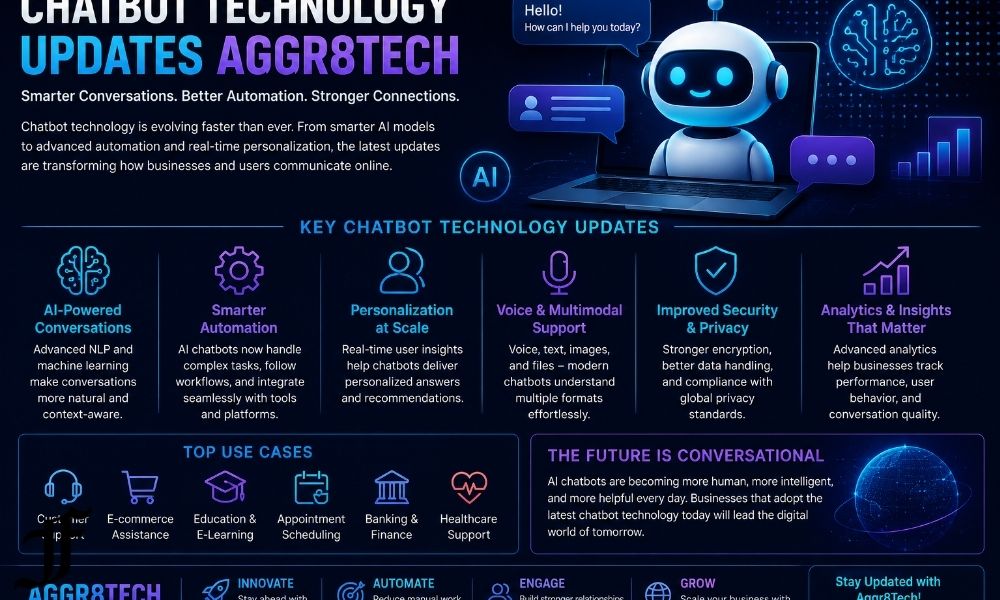
The digital world is moving fast, and chatbot technology updates aggr8tech has become a useful keyword for understanding how modern AI chatbots are changing online communication. Chatbots are no longer simple tools that answer basic questions. Today, they can support customers, write content, understand natural language, handle voice conversations, connect with business tools, and even work like digital assistants. As platforms such as ChatGPT, Claude, Gemini, Copilot, and other AI assistants continue to improve, chatbot technology is becoming more powerful, more human-like, and more useful for businesses and everyday users. Recent chatbot guides also show that leading tools are now being compared by use case, including writing, coding, productivity, research, customer support, and workplace automation.
What Does Chatbot Technology Updates Aggr8Tech Mean?
The phrase chatbot technology updates aggr8tech can be understood as a search term related to the latest improvements in chatbot systems, AI assistants, automation tools, and conversational technology. It connects the idea of chatbot updates with a tech-focused identity, making it useful for readers who want to understand what is changing in the chatbot industry.
Aggr8Tech appears to be used as a tech-style keyword or digital brand phrase connected with updates, innovation, and modern technology coverage. In this article, the focus is on chatbot technology itself: how it works, what has changed recently, and why it matters for businesses, creators, students, developers, and online users.
Why Chatbot Technology Is Growing So Fast
Chatbot technology is growing because people want faster answers and easier digital experiences. Customers do not always want to wait for email replies or call support teams. Businesses also want to reduce repetitive work and provide help around the clock.
AI-powered chatbots solve many of these problems. They can answer common questions, guide users through websites, recommend products, explain services, collect leads, book appointments, and transfer difficult cases to human agents. This makes chatbots valuable for e-commerce stores, banks, clinics, travel companies, education platforms, SaaS tools, and local businesses.
From Basic Bots to AI Assistants
Old chatbots were limited. They followed fixed scripts and often failed when users asked questions in a different way. These bots could only respond to specific keywords. If the question was not written exactly as expected, the chatbot became confused.
Modern AI chatbots are different. They use natural language processing and large language models to understand meaning, context, and user intent. This means users can ask questions in normal language, and the chatbot can respond more naturally. This shift has changed chatbots from simple website widgets into powerful digital assistants.
Major Chatbot Technology Updates in 2026
One of the biggest chatbot technology updates is the move from basic conversation to task completion. Modern AI assistants are not only answering questions; they are helping users complete real work. They can summarize documents, create emails, analyze data, write code, generate ideas, and organize information.
Another major update is multimodal AI. This means chatbots can work with text, images, audio, and sometimes video. A user can upload an image, ask a question about it, and receive a useful answer. This makes chatbots more practical for customer support, education, design, healthcare information, and technical troubleshooting.
Recent chatbot comparison guides also show that different AI assistants are now being ranked by their strengths. Some are better for writing and coding, some are stronger for research, while others are useful for workplace tools and productivity. This shows that the chatbot market is becoming more specialized.
AI Chatbots and Customer Support
Customer support is one of the most common uses of chatbot technology. Businesses use chatbots to answer FAQs, track orders, solve basic problems, and guide customers to the right department. This saves time for both customers and support teams.
The latest trend is context-aware support. Instead of giving generic answers, better chatbots can use company knowledge bases, customer history, product information, and previous conversation details to give more helpful replies. This makes support faster and more personal.
For example, a customer asking about a delivery delay does not want a general shipping policy. They want an answer about their order. Modern chatbots can connect with backend systems and provide that kind of specific support when properly integrated.
Personalization Is Becoming More Important
Personalization is one of the strongest chatbot updates. Users now expect digital tools to understand their needs. A chatbot that remembers preferences, understands previous questions, and gives relevant suggestions feels more useful than one that starts from zero every time.
In e-commerce, personalized chatbots can recommend products based on browsing behavior. In education, they can adjust explanations based on a student’s level. In healthcare-related information platforms, they can guide users toward general resources while reminding them to seek professional medical advice. In business tools, they can help teams find the right files, tasks, or reports.
Voice Chatbots Are Improving
Voice chatbots are also becoming more advanced. Many users prefer speaking instead of typing, especially on mobile devices. Voice-based AI assistants can help with hands-free tasks, customer support calls, language practice, accessibility, and smart home control.
The latest voice chatbot updates focus on natural tone, faster responses, better speech recognition, and improved conversation flow. Instead of sounding robotic, modern voice assistants are becoming smoother and more expressive. This makes them more useful for real-time interactions.
Chatbots and Business Automation
Businesses are using chatbots for automation because they reduce repetitive work. A chatbot can collect customer details, qualify leads, answer pricing questions, schedule meetings, send reminders, and create support tickets. This allows human teams to focus on higher-value work.
For small businesses, chatbot automation can be especially helpful. A small team may not have enough staff to answer messages all day. A chatbot can handle basic replies and make the business look more professional. When used correctly, it improves response time and customer satisfaction.
Chatbot Technology in E-Commerce
E-commerce websites use chatbots to improve shopping experiences. A chatbot can help users find products, compare options, check delivery details, explain return policies, and recover abandoned carts. This can increase sales because customers receive help at the exact moment they need it.
The best e-commerce chatbots do not only push products. They guide customers. They ask what the user needs, recommend suitable options, and answer concerns before checkout. This creates a smoother buying journey.
Chatbots in Education
Education is another field where chatbot technology is growing. Students can use AI chatbots to understand difficult topics, summarize notes, practice writing, generate quiz questions, and get study guidance. Teachers can use chatbots to create lesson plans, worksheets, and explanations.
However, education chatbots must be used responsibly. Students should not rely on them for cheating or copying answers. The best use is learning support. A chatbot can explain a topic in simple words, but students still need to think, practice, and verify information.
Chatbots in Healthcare Information
Chatbots are also used in healthcare information, but this area requires extra care. A chatbot can help users understand general health topics, appointment steps, clinic hours, or basic wellness guidance. It can also help route users to the right service.
However, chatbots should not replace doctors. Health-related chatbot systems must avoid giving unsafe diagnosis or treatment instructions. They should encourage users to contact qualified professionals for serious symptoms, emergencies, or personal medical decisions.
Chatbots and Cybersecurity
As chatbots become more powerful, cybersecurity becomes more important. AI chatbots may handle sensitive information such as customer names, emails, order numbers, business data, and private messages. If this data is not protected, users can be harmed.
Modern chatbot updates now focus more on privacy, access control, safe data handling, and secure integrations. Businesses should choose chatbot tools that protect user data and follow strong security practices. They should also avoid feeding private information into untrusted AI systems.
The Problem of Hallucinations
One major challenge in chatbot technology is hallucination. This happens when an AI chatbot gives an answer that sounds confident but is not true. It may invent facts, names, numbers, or sources. This is a serious issue for businesses, education, law, health, finance, and journalism.
To reduce hallucinations, many chatbot systems now use retrieval-based answers. This means the chatbot pulls information from trusted documents, websites, or databases instead of relying only on its general training. This makes answers more reliable when the source material is accurate.
Human Handoff Still Matters
Even the best chatbot cannot solve everything. Some problems require empathy, judgment, negotiation, or special approval. That is why human handoff remains important.
A good chatbot should know when to transfer a user to a real person. It should also pass along the conversation history so the customer does not need to repeat everything. This creates a smoother support experience and prevents frustration.
Chatbots and AI Agents
One of the biggest changes in chatbot technology is the rise of AI agents. A normal chatbot answers questions. An AI agent can take actions. It may book meetings, update spreadsheets, create reports, send messages, manage tasks, or connect with business software.
This is a major step forward. Instead of only talking about work, AI agents can help complete work. However, businesses must set clear permissions. An AI agent should not make important changes without proper controls, especially when money, customer data, or legal information is involved.
Multilingual Chatbots
Multilingual chatbots are becoming more useful for global businesses. A company can serve users in different languages without hiring separate support teams for every region. This helps websites reach more customers and provide better service.
For countries with many languages, multilingual chatbot technology can improve access. Users can ask questions in the language they are most comfortable with. This makes digital tools more inclusive and practical.
Chatbots for Content Creation
Many people now use chatbots for writing and content creation. They can help with blog outlines, product descriptions, email drafts, social captions, video scripts, SEO ideas, and grammar improvement. This saves time for marketers, bloggers, students, and business owners.
However, chatbot-generated content should still be edited by humans. AI can produce useful drafts, but human review is needed for accuracy, originality, brand voice, and emotional quality. The best content comes from using AI as an assistant, not as a replacement for human creativity.
Chatbots and Search Experience
Search is also changing because of chatbot technology. Instead of typing keywords and clicking many links, users can ask a chatbot and receive a direct answer. This creates a more conversational search experience.
This change affects SEO. Websites now need clear, helpful, well-structured content that AI systems can understand. Businesses should focus on answering real questions, using natural language, and building trust through accurate information.
Benefits of Chatbot Technology
Chatbot technology offers many benefits. It improves response speed, reduces repetitive work, supports users 24/7, lowers support pressure, and creates better digital experiences. It can also help businesses collect leads, organize workflows, and provide instant guidance.
For users, chatbots make online tasks easier. Instead of searching through long pages, users can ask a question and receive a direct answer. This is why chatbots are becoming common across websites, apps, and workplace tools.
Challenges of Chatbot Technology
Despite the benefits, chatbot technology has challenges. Poorly trained bots can annoy users. Inaccurate answers can damage trust. Privacy issues can create risk. Over-automation can make customers feel ignored. Businesses must balance automation with human care.
The best chatbot systems are not built only for speed. They are built for usefulness. They provide clear answers, know their limits, and support users without creating confusion.
Future of Chatbot Technology Updates Aggr8Tech
The future of chatbot technology updates aggr8tech will likely focus on smarter, safer, and more connected AI systems. Chatbots will become better at understanding context, using business data, handling voice conversations, and completing tasks through AI agents.
We may also see more industry-specific chatbots. A legal chatbot, medical chatbot, e-commerce chatbot, education chatbot, and finance chatbot all need different rules and knowledge. Specialized chatbots will become more valuable because they can serve users with more relevant answers.
Final Thoughts
Chatbot technology updates aggr8tech represents the fast-moving world of AI-powered conversations. Chatbots have changed from simple scripted tools into intelligent assistants that can support customers, create content, automate tasks, and improve digital experiences.
However, this technology must be used carefully. Accuracy, privacy, security, and human oversight still matter. The best chatbot systems are not only smart; they are responsible. As AI continues to improve, chatbots will become a normal part of how people work, shop, learn, and communicate online.
FAQs About Chatbot Technology Updates Aggr8Tech
What is chatbot technology updates aggr8tech?
Chatbot technology updates aggr8tech is a keyword related to the latest improvements in AI chatbots, conversational tools, automation, and digital assistant technology.
How are modern chatbots different from old chatbots?
Old chatbots followed fixed scripts. Modern AI chatbots understand natural language, context, user intent, and can perform more advanced tasks.
What are the biggest chatbot trends?
Major trends include AI agents, voice chatbots, multimodal AI, personalization, customer support automation, multilingual chatbots, and secure business integrations.
Can chatbots replace human support teams?
Chatbots can handle many simple tasks, but they should not fully replace humans. Complex, emotional, or sensitive issues still need human support.
Are AI chatbots safe to use?
AI chatbots can be safe when built with strong privacy and security practices. Users should avoid sharing sensitive data with unknown or untrusted chatbot tools.
What is an AI agent?
An AI agent is a more advanced chatbot that can take actions, such as booking meetings, updating records, sending messages, or completing workflow tasks.
Why do chatbots sometimes give wrong answers?
Chatbots can give wrong answers because of hallucinations, outdated information, poor training data, or missing context. Trusted sources and human review help reduce this problem.
How can businesses use chatbots?
Businesses can use chatbots for customer support, lead generation, appointment booking, product recommendations, order tracking, and internal workflow automation.
Are chatbots useful for small businesses?
Yes. Small businesses can use chatbots to answer common questions, save time, improve response speed, and support customers even outside working hours.
What is the future of chatbot technology?
The future includes smarter AI assistants, better voice interaction, stronger personalization, safer data handling, and more specialized chatbots for different industries.
Visit for more info: Famousdaily.co.uk